

Vision or Hallucination: The 6 Execution Gaps Manifesto
Bridging the divide between strategic ambition and reality
In the post-AI era, the strategic bottleneck has fundamentally shifted. We have moved from a world where the challenge was generating a vision to one where the challenge is absorbing it. Artificial Intelligence has commoditised strategy formulation, enabling the creation of a market-entry plan or a digital roadmap in seconds. Yet, it remains powerless to navigate the deep-seated human and structural friction inherent in a legacy organisation.
The uncomfortable truth facing boards today is the emergence of an Implementation Paradox: as our tools for planning become more sophisticated, our actual rate of realised ROI is stalling. If an organisation lacks the muscle to carry the weight of its ambition, the strategy is not a roadmap; it is a hallucination.
In my experience advising international organisations through complex transformations, I have observed a critical shift over the last twenty-four months. A pattern of execution failure has emerged that is not only persistent but rapidly intensifying. As the pace of technological change accelerates, the chasm between strategic intent and operational reality is widening, leaving even the most resolute leaders struggling to anchor their vision.
The Anatomy of the 6 Execution Gaps
Strategic value does not evaporate instantaneously; it leaks out through predictable, structural friction points. Whenever I am invited to evaluate whether a corporate strategy is a viable trajectory or merely an expensive hallucination, I encounter the same specific challenges. Through rigorous analysis of these recurring themes, I have distilled them into six primary Execution Gaps.
In this era of AI acceleration, the 6 Execution Gaps model provides the definitive indicators of value leakage between the boardroom and the frontline. This framework serves as a principal diagnostic tool to evaluate organisational health and transformation readiness. We utilise it to design new strategies, realign failing initiatives, and, crucially, to continuously monitor the strength of the Change Muscle within an organisation. By identifying these gaps, leaders can transition from speculative investment to a state of sustained, high-performance execution.
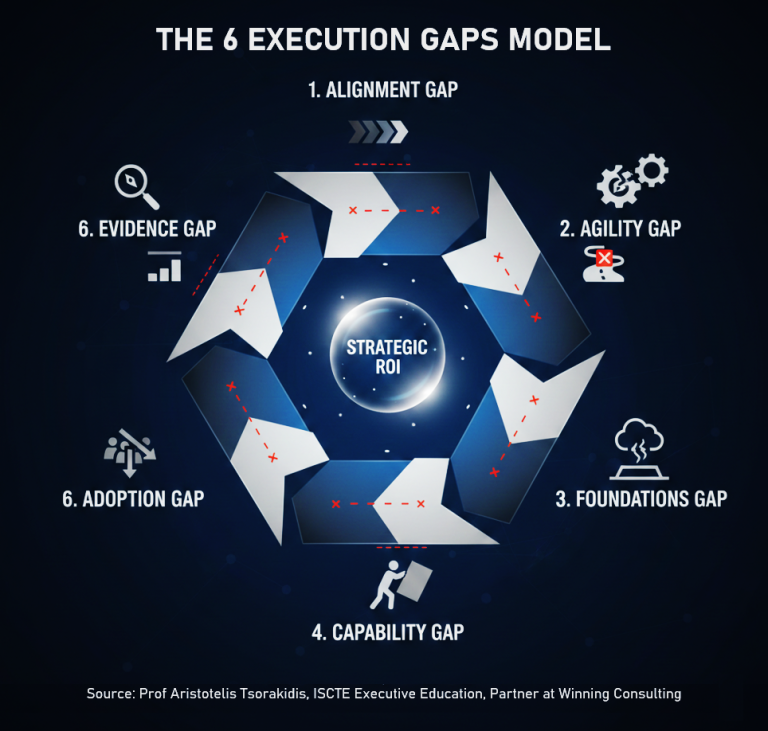
1. The Alignment Gap This is the “lost in translation” phase. While the C-suite sees a clear 2026 destination, the ‘Middlegame’, that critical layer of middle management, is where strategic intent often meets its greatest friction. Research suggests that the vast majority of the workforce remains disconnected from the strategic core, often trapped in conflicting operational priorities. In a post-AI world, alignment requires more than a strategic announcement; it requires a shared operating vocabulary that survives the journey from the top floor to the shop floor.
2. The Agility Gap Many organisations are paralyzed by a lack of speed and flexibility. It is not just about slow decisions; it is about rigid execution. Linear approval cycles and legacy stage-gates act as a handbrake on initiatives that require rapid pivots or iterative problem-solving. When 87% of leaders report that their current structures are a primary barrier to their 2026 goals, the solution isn’t just “fewer meetings”. It is a systemic shift from bureaucratic rigidity to adaptive execution.
3. The Foundations Gap You cannot build 21st-century intelligence on 20th-century infrastructure. The “Foundations Gap” is the silent killer of digital ROI. Today, CIOs report that over 70% of their AI and data initiatives are delayed or failing specifically due to legacy technical debt. If the “engine room” is clogged with fragmented data, your AI strategy will simply help you fail faster and at a higher cost.
4. The Capability Gap There is a widening chasm between the ambition of the strategy and the actual capabilities available to deliver it. We are facing a critical Dual Deficit defined by a widespread shortage of AI and digital competencies needed across all functions paired with a lack of leading with people skills and practices indispensable for sustaining high performance. Closing this gap requires a multifaceted skillset. Execution excellence now demands modern project management and technical fluency fused with the negotiation, intellectual humility, and aggressive curiosity required to navigate complexity and drive alignment. You cannot drive 21st century innovation with a 20th century skillset. Without this fusion of capabilities, for every billion dollars invested, over a hundred million is lost.
5. The Adoption Gap This is where structural change hits the wall of human capacity. We are currently navigating a peak in “Change Fatigue” where employee willingness to support new initiatives has plummeted by nearly half in the last few years. But fatigue is often a symptom of poor design. Bridging this gap requires moving beyond mechanical training plans to embrace strategies grounded in neurocognitive science and the emotional journey of transformation. Deployment is a technical milestone while Adoption is a human result. If the strategic shift does not stick at the frontline the investment is essentially a write off.
6. The Evidence Gap The inability to attribute outcomes to actions is the final leak. Despite the influx of data, fewer than 20% of organisations have a high level of maturity in linking their transformation spend directly to ROI or tangible business impact. Critically, this data void compromises decision-making; without a clear “Evidence Loop”, leaders cannot validate their strategic hypotheses, leaving them trapped in a cycle of decisions based on unverified assumptions rather than proven value.
The Path to Execution Maturity
Execution excellence is the only sustainable advantage in an era of AI acceleration. To survive the next wave of disruption, organisations must move beyond reactive delivery and systematically resolve the six Execution Gaps. The winners of the next decade will not be the most visionary companies but the ones with the narrowest gaps between their boardroom and their engine room.
True Execution Maturity is not an abstract ideal. It is the discipline of continuously closing the six gaps that drain strategic value. The question for any leader today is no longer “What is our vision?” but “Where is our value leaking?”


Aristotelis has extensive experience leading complex international transformation programs and operational change initiatives. As an academic, speaker, and executive educator, he specializes in large-scale transformation, execution, leadership, and organizational complexity across industries and geographies.