Skip to content

Transformation Readiness Score

Your AI and digital strategies look perfect on paper.
Measure your capacity to produce actual ROI on the ground.

Measure your organization’s real capacity to turn ambition into results. 

In the post-AI era, strategy formulation has become commoditised.

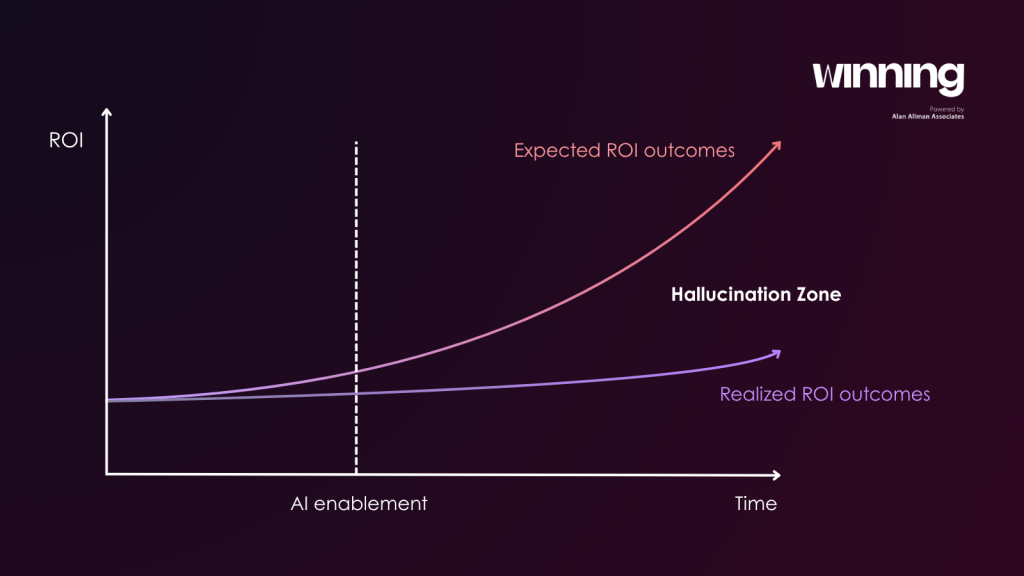
We are now facing the Implementation Paradox: while AI can generate complex plans and roadmaps in seconds, and expectations for rapid ROI have escalated, actual realised ROI outcomes have stalled.

Vision is essential, but it is no longer enough. Move from guessing why projects stall to identifying the specific structural friction stopping your growth.

The Transformation Readiness Score (TRS) helps leaders identify exactly where value is leaking between the boardroom and the frontline, transforming strategy into a predictable execution machine.

Why Transformation effortoften fail

The problem is not lack of strategy. It is lack of the execution muscle. 

Most organisations fail because their vision gets trapped in predictable structural friction: misaligned incentives, bureaucratic drag, legacy systems, capability deficits, weak adoption, and poor evidence loops.

If an organisation lacks the structural muscle to carry the weight of its ambition, strategy stops being a roadmap and becomes an illusion.

What does the Transformation Readiness Score measure?

A rigorous diagnostic of your organization’s transformation readiness.

The Transformation Readiness Score is built on the 6 Execution Gaps Model, a diagnostic framework designed to measure an organization’s structural ability to translate strategic intent into operational reality. 

Rather than focusing on superficial project metrics, the TRS assesses the real operating conditions of the business across six critical dimensions: 

  • Alignment – Is strategy truly translated into frontline behaviour? 
  • Agility – Can the organization adapt fast, or is execution trapped by bureaucracy? 
  • Foundations – Are systems and data enabling transformation, or slowing it down? 
  • Capability – Do leaders and teams have the fluency to execute in a post-AI world? 
  • Adoption – Is change being embedded, or merely deployed? 
  • Evidence – Can the organisation prove business impact, or only report activity?  

How it works:

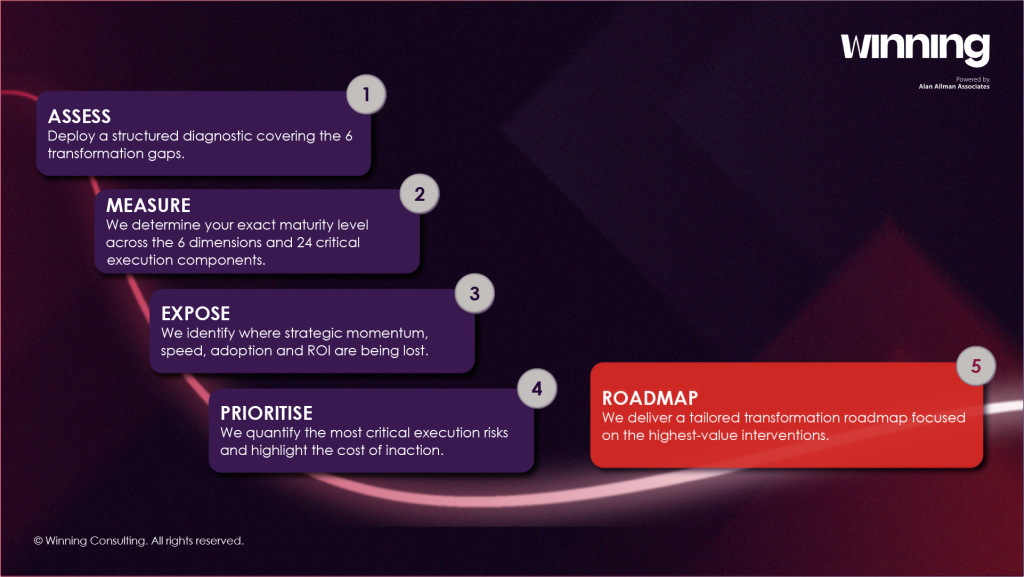
Start with introspection. Complete the assessment internally and get a structured view of your execution maturity across the six critical transformation gaps.

Go beyond self-perception. Validate your internal baseline with Winning’s technical and strategic diagnostic. Receive a precise expert-backed roadmap to eliminate structural friction and embed high-speed execution.

From diagnosis to execution roadmap 

The Transformation Readiness Score (TRS) combines a structured maturity assessment with a forensic execution lens, grounded in real organisational friction.

Execution Maturity is Measurable

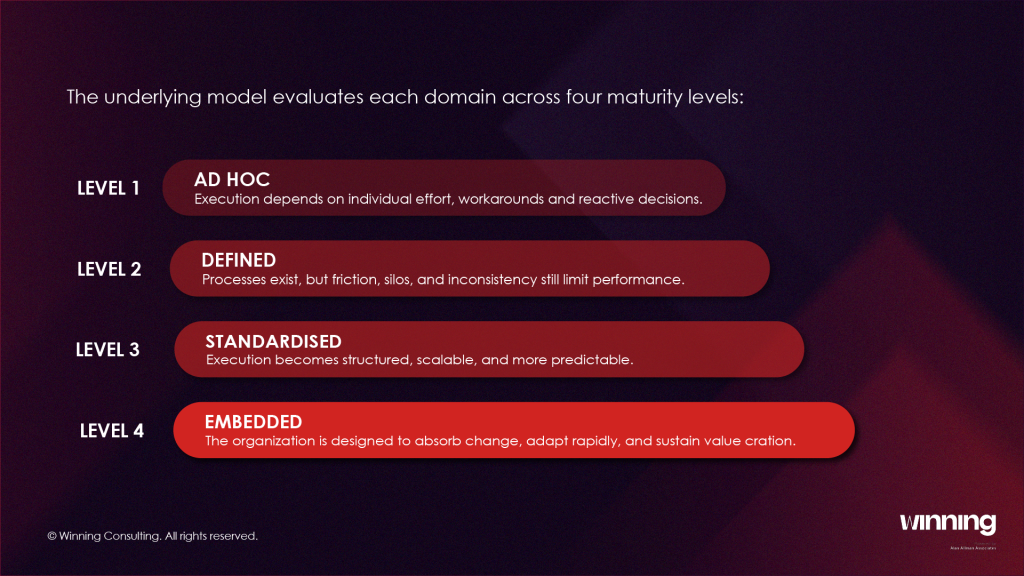
Execution maturity is not an abstract concept. The Transformation Readiness Score (TRS) evaluates your exact operating reality. The underlying model assesses 6 critical dimensions and 24 specific components across 4 maturity levels, mapping your organisation against 96 distinct execution states.

The underlying model evaluates each domain across four maturity levels: 

What you’ll receive 

Map your execution gaps, make them impossible to ignore, and trigger immediate action.

At the end of the assessment, you receive a structured executive report with:

A report designed not just to describe the gaps, but to make them impossible to ignore. And to take actions 

The report explicitly articulates the cost of inaction. It highlights the operational drag, wasted investment, slower delivery, technical debt, poor adoption, and weak ROI attribution caused by operating at a lower maturity level.

If your strategy is stalling, taking the TRS Assessment is the right decision.

Stop losing ROI to structural friction. Validate your execution muscle today. Choose the self-assessment to establish your baseline or secure our expert diagnostic to build your transformation roadmap.